
When I first started my PhD in 2024, I wanted to understand the association between Islamic finance and climate risk, but finding literature that directly linked both fields was not easy. That gap became one of the reasons I chose this research path.
Islamic Finance in the face of climate realities
As time passed, I have seen this discussion begin to grow. Climate conversations are becoming more visible in Muslim-majority countries, and many policy discussions are also recognising the untapped potential of Islamic finance in supporting climate action. This is crucial because a lot of Muslim countries face increasing climate impacts that interact with existing socio-economic challenges. This raises a deeper question: how can Islamic finance move beyond its potential as a solution and become more practical, impactful, and transformative?
I am from Indonesia, the world’s largest Muslim-majority country and a country located on the Pacific Ring of Fire. Floods, landslides, earthquakes, droughts, extreme weather, and the damage they cause are not distant issues for us. They are part of people’s everyday reality. What makes these events more painful is that their impacts are often exacerbated by human activity: deforestation, poor land management, weak climate literacy, and limited financing for recovery.
The sight of Aceh flash floods in late 2025 brought to mind that climate risks aren’t just an environmental problem but also a matter of justice. When a community does not have the wealth to recover quickly, the most vulnerable pay the heaviest price. Adaptation isn’t just about building sea walls or better drainage; it’s about protecting people, restoring livelihoods, and ensuring no one is left behind. This is exactly where Islamic finance can bring something worthwhile.
Tayyib Inspired Finance
Islamic finance means more than avoiding interest or developing Shariah-compliant equivalents of conventional financial products. Shariah compliance is vital, but Islamic finance has a deeper moral base. At the core of Maqasid al-Shariah, Islamic finance is rooted in justice, stakeholder responsibility, redistribution, risk-sharing, and protecting the vulnerable. These values deeply align with climate action.
Yet, the industry’s ethical promise has not always fully delivered transformational outcomes. The real question is whether Islamic finance can move from being Shariah-compliant to being truly Tayyib: good, ethical, beneficial, and meaningful for people and the planet. The Tayyib approach asks deeper questions. It asks not only whether something is allowed, but also whether it produces benefit while actively contributing to justice, balance, and well-being.
Islam teaches that Earth is a sacred trust created in balance, and human beings are entrusted as khalifah, or stewards, to preserve that balance. Climate action, from this perspective, should not be seen as separate from Islamic finance, but as part of its ethical foundation.
Islamic Finance: a tool for climate action
My PhD research examines this systematically. My findings suggest that countries with more developed Islamic finance sectors tend to exhibit greater climate resilience and lower vulnerability, particularly among OIC economies. This is important because many Muslim-majority countries are among the most vulnerable to climate risk, while also having limited financial and institutional capacity. In such contexts, Islamic finance may offer an ethical pathway for a just transition.
However, ethical finance alone will not automatically solve climate-imposed challenges. Values must be translated into policies, regulations, and products. Climate risk needs to be integrated into Islamic finance regulation and supervision. Shariah governance should also engage more deeply with environmental and social impact, not only with contractual compliance. At the same time, Islamic social finance instruments such as zakah and waqf can be blended with green sukuk, public finance, and private-sector capital, which is crucial for adaptation projects characterised by strong social impact but limited commercial returns.
Another issue that matters to me is climate literacy. Living in the UK, where the green transition is widely discussed, made me reflect on communities back home where climate literacy is not equally accessible. Without awareness, climate action feels distant. Without finance, resilience remains limited. Without justice, transition can create new inequalities.
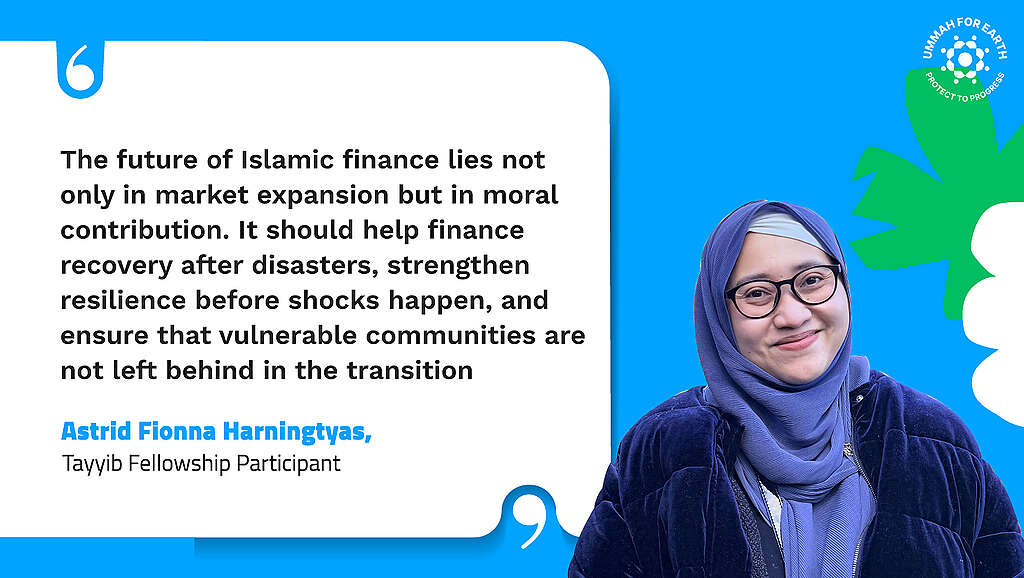
The future of Islamic finance lies not only in market expansion but in moral contribution. It should help finance recovery after disasters, strengthen resilience before shocks happen, and ensure that vulnerable communities are not left behind in the transition. The promise of Islamic finance is not simply to be different from conventional finance. Its promise is to be better: more just, more responsible, more inclusive, and more aligned with the protection of life and the planet.
This is why the Global Tayyib Fellowship has been very meaningful for me. It has given me a space to connect with like-minded people who believe that Islamic finance should not stay trapped in academic papers, but should be part of a wider movement to restore balance.