
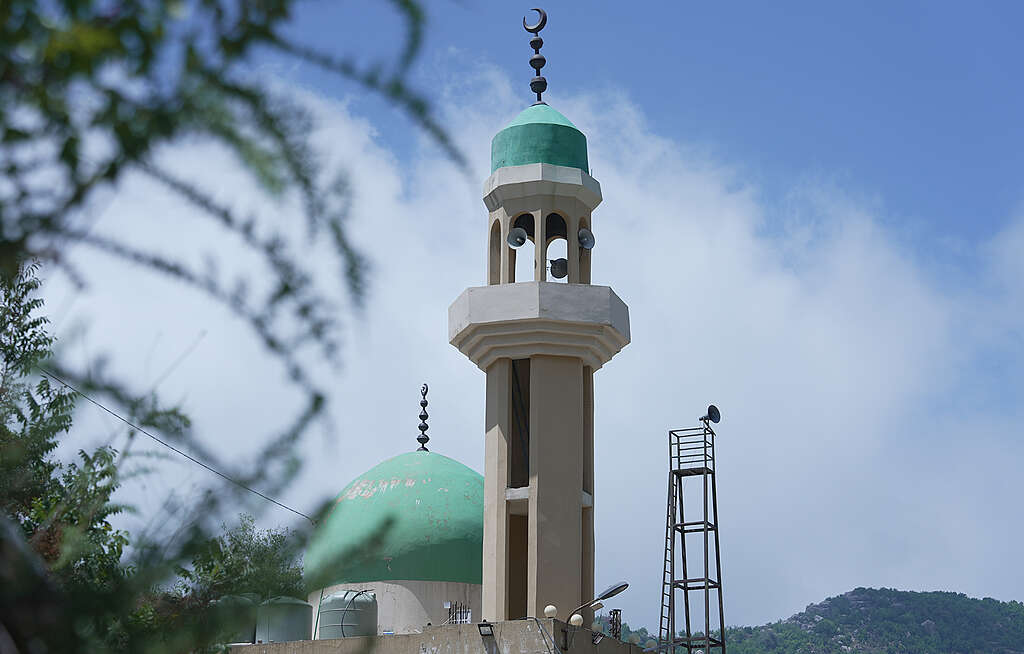
More than 1.8 Billion Muslims around the world consider Mosques as places of worship and a center of their communities’ daily life. Mosques serve as a refuge of peace, contemplation, and gathering. Yet, amidst the increasing impacts of the climate crisis, these sacred spaces carry a great deal of unexplored potential.

More than 1.8 Billion Muslims around the world consider Mosques as places of worship and a center of their communities’ daily life. Mosques serve as a refuge of peace, contemplation, and gathering. Yet, amidst the increasing impacts of the climate crisis, these sacred spaces carry a great deal of unexplored potential.
Across Muslim countries worldwide, people live at the frontlines of the climate crisis. From heatwaves and water scarcity to energy poverty, vulnerable communities are bearing the heaviest cost. Is there not a solution existing at the heart of our local communities to mitigate the worsening environmental and socio-economic burdens?
By shifting our perspective of Mosques, from religious spaces only to a center for active stewardship, we can transform them into decentralized community resilience hubs that protect the dignity of human life and empower surrounding neighborhoods.
Rooted in Faith: balancing justice and infrastructure
This transformation is an expression of Islamic environmental principles of balance, stewardship, and wisdom, and it goes beyond technical upgrades. Faith demands accountability, inviting us to protect the most vulnerable and to create a sense of collective solidarity and justice. From an Islamic perspective, caring for the environment goes together with caring for the community.

On the other hand, in our present times, the climate crisis exacerbates threats and harms, deeply intensifying existing socioeconomic inequalities. Frontline Muslim communities, especially those living in rural and marginalized regions, often experience the heaviest toll of environmental degradation while remaining excluded from global climate decision-making. At the same time, it is worth noting that many mosques function only as passive consumers of energy and water, without harnessing their significant physical presence as well as capacity to help with climate mitigation and adaptation. A gap of awareness still exists regarding how these places of worship can act as sanctuaries for the local communities.
By providing mosques with renewable energy, rainwater harvesting facilities, and eco-friendly infrastructure, this approach helps bridge the mentioned gap. This changes the paradigm altogether to one where mosques, once mere passive recipients of resources, become active agents of change in their local communities. It makes it clear that justice in the energy transition is not simply a question of a policy change, but a question of spirituality as well.
Let us talk about the socio-economic benefits!
When Mosques become community resilience hubs, surrounding neighborhoods gain socioeconomic safety nets that are directly able to address issues related to poverty, public safety, and local equity. From an economic point of view, equipping these sacred spaces with solar energy and rainwater-harvesting infrastructure significantly reduces mosque utility costs, allowing financial resources to be reinvested into local welfare programs.

This clean power can be extended past the mosque walls to illuminate neighborhood streetlights in order to ensure nighttime safety or even supply surplus power to neighboring homes experiencing energy poverty.
In times of natural disasters and extreme weather events, such as heatwaves or power grid breakdowns, mosques can play the role of critical decentralized emergency shelters. Offering access to clean water distribution points and eco-friendly cooling facilities, they protect the health of elderly and low-income residents who cannot afford air conditioning, preventing heat-related costly hospitalization.
Furthermore, the benefits extend to guaranteeing economic self-sufficiency in the future as a result of soft infrastructure. For example, utilizing mosque grounds for community gardens directly enhances local food security and protects people from fluctuating market prices. At the same time, the establishment of environmental committees results in the emergence of grassroots leadership and the creation of vocational training for local youth and Imams. This will turn Mosques into effective factors of local economic security, demonstrating that environmental stewardship is capable of becoming a driver of a just transition.